3V0-24.25 Reliable Braindumps Ppt, Latest 3V0-24.25 Exam Labs
Wiki Article
What's more, part of that TestInsides 3V0-24.25 dumps now are free: https://drive.google.com/open?id=114ePv2m01Z5vUTCihYWXCnSXI1M-dTWG
TestInsides's VMware 3V0-24.25 exam training materials are the necessities of each of candidates who participating in the IT certification. With this training material, you can do a full exam preparation. So that you will have the confidence to win the exam. TestInsides's VMware 3V0-24.25 Exam Training materials are highly targeted. Not every training materials on the Internet have such high quality. Only TestInsides could be so perfect.
VMware 3V0-24.25 Exam Syllabus Topics:
| Topic | Details |
|---|---|
| Topic 1 |
|
| Topic 2 |
|
| Topic 3 |
|
| Topic 4 |
|
| Topic 5 |
|
>> 3V0-24.25 Reliable Braindumps Ppt <<
Latest 3V0-24.25 Exam Labs - Exam 3V0-24.25 Cost
Because VMware 3V0-24.25 exam is concerning the future and the destiny of IT people, they pay more attention to the certification. When you decide to choosing IT industry, you have proved your ability. However, what we learn is not enough at all. VMware 3V0-24.25 Certification will be a big challenge for the candidates. If you decide to join our TestInsides, we guarantee your success in the first attempt. If you fail, FULL REFUND!
VMware Advanced VMware Cloud Foundation 9.0 vSphere Kubernetes Service Sample Questions (Q16-Q21):
NEW QUESTION # 16
How should an administrator enable autoscaling for a vSphere Kubernetes Service (VKS) cluster?
- A. Create a NodePool with autoscaling enabled.
- B. Create a VKS cluster with autoscaler annotations.
- C. Install the Cluster Autoscaler (standard package) for the cluster environment.
- D. Update the NodePool YAML to enable the autoscaling feature.
Answer: C
Explanation:
In VCF 9.0, cluster autoscaling is delivered as anoptionalcapability that requires installing theCluster Autoscaleras a standard package. The VCF 9.0 materials explicitly call out Cluster Autoscaler as an optionally installed package for vSphere Kubernetes Service, alongside other optional packages (for example, Harbor, Velero, Istio, etc.). The release information further emphasizes that autoscaling features (including newer behaviors such as scaling from/to zero for supported VKr versions) require that "the autoscaler standard package" be installed.
Operationally, installing the autoscaler package provides the controller that watches pending pods and node utilization signals and then drives the required changes in desired worker capacity. After that controller is present, you typically express scaling intent through the cluster's declarative configuration (for example, worker pool/node pool constraints and limits) so the autoscaler can act within the boundaries you define.
Without the autoscaler package, changing replica counts or expecting automatic node growth/shrink will not produce autoscaling behavior because the control loop that performs those actions is missing.
NEW QUESTION # 17
The administrator has completed a proof of concept for using Harbor as a container registry part of the Supervisor services and you are tasked for cleaning up the environment, starting with the unlnstall of the Harbor Supervisor service.
Drag and drop the four tasks into the correct order from Configuration Options on the left and place them into the Configuration Sequence on the right. (Choose four)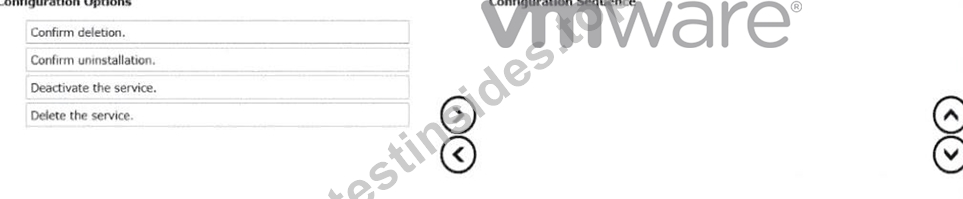
Answer:
Explanation: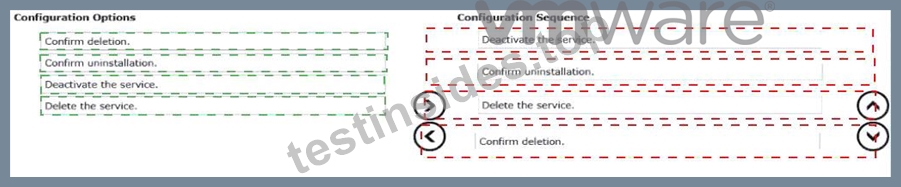
Explanation:
Configuration Sequence (in order):
Deactivate the service.
Confirm uninstallation.
Delete the service.
Confirm deletion.
Uninstalling a Supervisor Service cleanly follows a "stop/remove/cleanup" pattern to avoid orphaned components and to ensure the Supervisor isn't still reconciling the service while you remove it. First, youDeactivate the serviceso the Supervisor stops managing and running the Harbor service components. This prevents new service resources from being created while you are attempting to remove them and allows the platform to transition the service into a non-operational state safely.
Next, youConfirm uninstallationto initiate the removal workflow. This step acknowledges that the service's deployed components (such as pods, controllers, and any associated objects) will be removed from the Supervisor-managed environment. After the uninstall workflow is initiated and the service is no longer active, you proceed toDelete the serviceto remove the Harbor service registration/entry from the Supervisor Services list, ensuring it is no longer available to namespaces or consumers. Finally, youConfirm deletionas the last safeguard, since deletion is typically destructive and removes the service definition from the environment's available services catalog.
NEW QUESTION # 18
A platform operator runs a kubectl command and receives the error " Couldn't get current server API list " .
Which command resolves the error?
- A. kubectl config use-context
- B. kubectl config get-clusters
- C. kubectl vsphere login
- D. kubectl vsphere vm web-console
Answer: C
Explanation:
In the VMware Cloud Foundation (VCF) 9.0 ecosystem, specifically when interacting with the vSphere Supervisor or vSphere Kubernetes Service (VKS) , the error " Couldn't get current server API list " is a classic indicator of an authentication or connectivity failure between the local workstation and the Kubernetes API server. This typically occurs because the short-lived security token stored in the local kubeconfig file has expired, or the user has not yet established a valid session with the Supervisor.
The definitive resolution is to run the kubectl vsphere login command. This command is part of the vSphere CLI plugin and is specifically designed to facilitate the authentication flow between the developer ' s machine and the vSphere environment. When executed, it triggers the identity provider (IdP) workflow-utilizing OpenID Connect (OIDC) via the integrated Pinniped service-to verify the user ' s credentials. Once authenticated, the plugin automatically retrieves the necessary cluster connection details and updates the local kubeconfig with a fresh, valid bearer token and the correct server context. While kubectl config use-context (Option A) can switch between existing profiles, it cannot resolve a missing or expired API session. By running the login command, the platform operator ensures that the kubectl client can once again communicate with the declarative API of the Supervisor, allowing for continued management of namespaces, workload clusters, and associated SDDC resources.
NEW QUESTION # 19
A DevOps Engineer is architecting a "Hybrid-Cloud-Native" application stack to be deployed in the finance-app namespace.
Architecture Requirements:
1. Frontend: Stateless Nginx web servers running as containers, managed by Kubernetes, scaling based on CPU.
2. Backend: A legacy Microsoft SQL Server database running on Windows Server 2019. The DBA team demands full OS access and specific storage performance policies, preventing containerization.
3. Networking: The Frontend must connect to the Backend over the internal namespace network.
Review the proposed deployment strategy:
# Frontend Manifest
apiVersion: apps/v1
kind: Deployment
metadata:
name: web-front
spec:
replicas: 3
...
# Backend Manifest
apiVersion: vmoperator.vmware.com/v1alpha1
kind: VirtualMachine
metadata:
name: sql-backend
spec:
imageName: win-2019-sql.ova
className: guaranteed-xlarge
storageClass: sql-perf-policy
networkInterfaces:
- networkName: default
Which statements correctly validate this design for vSphere with Tanzu? (Select all that apply.)
- A. The SQL Server VM must be manually created in vCenter first, then "onboarded" to the namespace.
- B. Because both the Pods and the VM are in the same Namespace and the VM uses the default network, they will share the same NSX Tier-1 Gateway context (or vDS segment), enabling direct connectivity.
- C. The Frontend Deployment should utilize a Kubernetes Service to expose itself, while the Backend VM can be accessed by the Frontend using the VM's assigned IP or DNS name (if external DNS is configured).
- D. This validly utilizes the VM Service for the SQL backend, allowing it to be provisioned as a VM (kind:
VirtualMachine) within the same namespace as the Frontend pods. - E. The Backend must be deployed as a vSphere Pod (kind: Pod) to communicate with the Frontend deployment; VMs cannot talk to Pods in the same namespace.
Answer: B,C,D
NEW QUESTION # 20
A VKS Administrator needs to configure a TKG cluster to support taking snapshots of persistent volumes backed by vSAN.
Review the following VolumeSnapshotClass manifest being prepared:
apiVersion: snapshot.storage.k8s.io/v1
kind: VolumeSnapshotClass
metadata:
name: csi-vsphere-snapclass
driver: csi.vsphere.vmware.com
deletionPolicy: Delete
Which additional step is required to ensure this class is usable by developers in the default namespace?
- A. The class must be assigned to the vSphere Namespace in the vSphere Client.
- B. A RoleBinding must be created to grant the default ServiceAccount use access to this class.
- C. No additional steps are required; VolumeSnapshotClass is a cluster-scoped resource, making it available to all namespaces once applied.
- D. The vSphere CSI driver must be manually installed via Helm.
Answer: C
NEW QUESTION # 21
......
At the TestInsides, we guarantee that our customers will receive the best possible 3V0-24.25 study material to pass the Advanced VMware Cloud Foundation 9.0 vSphere Kubernetes Service (3V0-24.25) certification exam with confidence. Joining this site for the 3V0-24.25 exam preparation would be the greatest solution to the problem of outdated material. The 3V0-24.25 would assist applicants in preparing for the VMware 3V0-24.25 Exam successfully in one go 3V0-24.25 would provide 3V0-24.25 candidates with accurate and real Advanced VMware Cloud Foundation 9.0 vSphere Kubernetes Service (3V0-24.25) Dumps which are necessary to clear the 3V0-24.25 test quickly. Students will feel at ease since the content they are provided with is organized rather than dispersed.
Latest 3V0-24.25 Exam Labs: https://www.testinsides.top/3V0-24.25-dumps-review.html
- 3V0-24.25 Reliable Exam Practice ???? 3V0-24.25 Valid Test Duration ???? 3V0-24.25 Certification Exam ???? Open website ⇛ www.verifieddumps.com ⇚ and search for ⇛ 3V0-24.25 ⇚ for free download ????Valid 3V0-24.25 Exam Test
- VMware certification 3V0-24.25 the latest examination questions and answers come out ???? Immediately open ▷ www.pdfvce.com ◁ and search for ▶ 3V0-24.25 ◀ to obtain a free download ⚽3V0-24.25 Updated Demo
- Quiz 2026 VMware 3V0-24.25 Authoritative Reliable Braindumps Ppt ⚪ Search for ▛ 3V0-24.25 ▟ and download it for free on ➽ www.practicevce.com ???? website ????3V0-24.25 Valid Test Duration
- VMware certification 3V0-24.25 the latest examination questions and answers come out ???? Download ✔ 3V0-24.25 ️✔️ for free by simply searching on ▶ www.pdfvce.com ◀ ????3V0-24.25 Reliable Cram Materials
- VMware certification 3V0-24.25 the latest examination questions and answers come out ???? Easily obtain free download of ✔ 3V0-24.25 ️✔️ by searching on ▶ www.practicevce.com ◀ ????Dumps 3V0-24.25 PDF
- What is the Most Trusted Platform to Buy VMware 3V0-24.25 Actual Dumps? ???? Easily obtain free download of ➡ 3V0-24.25 ️⬅️ by searching on { www.pdfvce.com } ????3V0-24.25 Certification Exam
- Valid 3V0-24.25 Test Answers ???? 3V0-24.25 Certification Exam ???? Valid 3V0-24.25 Exam Test ???? Enter [ www.pass4test.com ] and search for ➤ 3V0-24.25 ⮘ to download for free ????3V0-24.25 Reliable Cram Materials
- Training 3V0-24.25 Solutions ???? 3V0-24.25 Latest Exam Price ⏰ 3V0-24.25 Updated Demo ???? Go to website ➤ www.pdfvce.com ⮘ open and search for ➤ 3V0-24.25 ⮘ to download for free ????Reliable 3V0-24.25 Dumps Pdf
- 3V0-24.25 Updated Demo ???? 3V0-24.25 Official Cert Guide ???? Dumps 3V0-24.25 PDF ???? Search on “ www.practicevce.com ” for ➽ 3V0-24.25 ???? to obtain exam materials for free download ????Pdf 3V0-24.25 Format
- 3V0-24.25 Updated Demo ???? Valid 3V0-24.25 Exam Test ???? Pdf 3V0-24.25 Format ???? Open ⏩ www.pdfvce.com ⏪ enter 【 3V0-24.25 】 and obtain a free download ????Pdf 3V0-24.25 Format
- Training 3V0-24.25 Solutions ???? 3V0-24.25 Reliable Exam Practice ???? 3V0-24.25 Guide ???? Easily obtain ➠ 3V0-24.25 ???? for free download through ▶ www.verifieddumps.com ◀ ????3V0-24.25 Valid Test Duration
- wirelesswithvidur.com, hassanbnzv542685.actoblog.com, elijahbgec063128.wikikali.com, exceeddirectory.com, donnavykv919676.blogitright.com, geraldayxp587223.kylieblog.com, bookmarkloves.com, socialwoot.com, www.stes.tyc.edu.tw, bookmarkedblog.com, Disposable vapes
BTW, DOWNLOAD part of TestInsides 3V0-24.25 dumps from Cloud Storage: https://drive.google.com/open?id=114ePv2m01Z5vUTCihYWXCnSXI1M-dTWG
Report this wiki page